How to Measure Trailer Hitch Drop, Tongue Weight & Strap WLL
Measure receiver-to-coupler drop accurately, verify 10% to 15% tongue load against door-jamb payload, and size tie-down straps by Working Load Limit.
Measuring hitch drop and verifying tongue weight before ordering towing hardware prevents trailer sway, bottomed-out suspension and overloaded tie-downs. Park both the pickup truck and trailer on flat pavement, take two tape-measure readings, and check the numbers against your receiver class and door-jamb payload sticker.
Step-by-step hitch drop and rise measurement
To tow safely, the trailer frame must sit parallel to the road once coupled and loaded. Follow these four steps with the truck parked on level ground and tires inflated to normal towing pressure:
- Measure receiver height: Measure vertically from level pavement to the inside top edge of the truck hitch receiver opening.
- Level the trailer: Use the trailer tongue jack and a short carpenter level along the main trailer frame rail until the frame sits flat.
- Measure coupler height: Measure vertically from level pavement to the bottom lip of the leveled trailer coupler.
- Calculate drop or rise: Subtract the coupler height from the receiver height. If the receiver sits higher than the coupler (common on modern 4x4 pickups), you need that difference in hitch drop. If the coupler sits higher than the receiver, you need hitch rise.
Remember that hitching a loaded trailer compresses the truck rear springs by roughly 1 to 2 inches unless you run helper springs or a weight-distribution hitch. An adjustable ball mount covering a 4-inch to 9.5-inch span lets you dial in level height across utility trailers, boats and campers. See our adjustable trailer hitch comparison once you know your required drop range.
SAE hitch classes and receiver tube sizes
Always check the stamped rating label on your truck hitch cross-tube before matching a ball mount or coupler ball. Your safe towing limit is always the lowest rated link among vehicle tow capacity, hitch receiver, shank, hitch ball and trailer coupler.
| SAE Hitch Class | Receiver Opening | Typical Max GTW | Typical Max Tongue Weight |
|---|---|---|---|
| Class I | 1.25 inch | Up to 2,000 lbs | 200 lbs |
| Class II | 1.25 inch | Up to 3,500 lbs | 350 lbs |
| Class III | 2.0 inch | 5,000 to 8,000 lbs | 500 to 800 lbs |
| Class IV | 2.0 inch | 10,000 to 12,000 lbs | 1,000 to 1,200 lbs |
| Class V | 2.0 in HD or 2.5 in | 14,000 to 20,000+ lbs | 1,400 to 2,700+ lbs |
Keeping bumper-pull tongue weight in the 10% to 15% zone
For conventional ball-mount trailers, tongue weight should stay between 10% and 15% of total loaded trailer weight (GTW). A 6,000-pound loaded trailer should place 600 to 900 pounds on the hitch ball.
- Under 10% tongue weight: Too much cargo sits behind the trailer axle, lifting the tongue and triggering dangerous side-to-side highway sway when passing semis or descending grades.
- Over 15% tongue weight: Rear pickup suspension sags excessively, aiming headlights upward and unloading front steering and braking traction.
Plug your loaded trailer weight into our free Trailer Tongue Weight & Hitch Class Calculator to verify your 10% to 15% bounds instantly.
Sizing cargo tie-down straps by Working Load Limit (WLL)
Shifting cargo inside an open utility trailer or truck bed changes tongue weight mid-trip. Under US FMCSA cargo securement rules, the aggregate Working Load Limit of all tie-down straps securing a load must equal at least 50% of the cargo weight.
Manufacturers often print large break-strength numbers on retail packaging, while true WLL is one-third of minimum break strength. A strap advertised at 3,000 pounds break strength carries a 1,000-pound WLL. For a 1,600-pound ATV or pallet load, you need at least 800 pounds of aggregate WLL across four corner straps, plus extra margin for wear and sharp edges. Compare webbing ratings and hooks in our ratchet straps specification guide.
Common truck fitment questions
Should a trailer sit perfectly level behind a pickup truck?
Yes. A level trailer frame distributes weight evenly across tandem axles, improves trailer brake performance and lowers the risk of highway sway or rear-bumper drag on steep driveways.
Does trailer tongue weight count toward my pickup truck payload?
Yes. Tongue weight rests directly on the rear hitch receiver, so it subtracts pound for pound from the door-jamb payload rating alongside passengers, bed covers and cargo.
Why should I size ratchet straps by WLL instead of break strength?
Working Load Limit (WLL) is set by US cargo securement standards at one-third of minimum break strength. FMCSA rules require aggregate strap WLL to equal at least 50% of cargo weight.
Can I use a reducer sleeve to fit a 2-inch shank in a 2.5-inch receiver?
Heavy-duty reducer sleeves work for light to moderate loads, but the assembly is limited to the lowest rated component and can add rattle unless paired with tight pins or silencer pads.
More pickup & towing guides
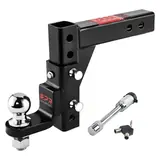 TowingBest Adjustable Trailer Hitch Picks for Trucks (2026)Compare 5 adjustable trailer hitches with dual and triple balls, rated up to 14,000 lbs GTW, with anti-theft pins and powder coatings.Read
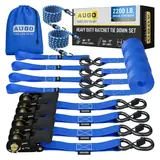 Tie-DownsBest Ratchet Straps for Trucks and Trailers (2026)A guide to heavy-duty tie-down straps, comparing break strength, working load limits, soft loops, and auto-retracting mechanisms.Read
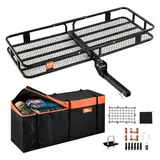 CargoBest Hitch Cargo Carrier Picks for Trucks and SUVs (2026)Compare top hitch cargo carriers by weight capacity, basket dimensions, folding shank designs, and included weather-resistant accessories.Read
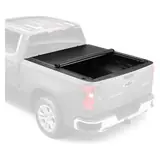 Bed CoversBest Tonneau Cover Picks for Pickup Trucks (2026)Compare top tonneau covers for Ford and GM trucks, from soft roll-up vinyl models to heavy-duty fiberglass tri-fold panels.Read