Trailer Tongue Weight, Hitch Class & Tie-Down Calculator
Enter your loaded trailer weight and cargo load to check safe tongue-weight bounds, SAE hitch class, receiver size and FMCSA tie-down WLL.
How to read these towing & tie-down numbers
Safe bumper-pull towing depends on keeping tongue weight between 10% and 15% of total loaded trailer weight (GTW). Below 10%, trailers become prone to highway sway; above 15%, rear pickup suspension sags and unloads front steering traction.
| SAE Hitch Class | Typical Receiver | Max GTW Range | Max Tongue Weight |
|---|---|---|---|
| Class I | 1.25 in | Up to 2,000 lbs | 200 lbs |
| Class II | 1.25 in | Up to 3,500 lbs | 350 lbs |
| Class III | 2.0 in | 5,000 - 8,000 lbs | 500 - 800 lbs |
| Class IV | 2.0 in | 10,000 - 12,000 lbs | 1,000 - 1,200 lbs |
| Class V | 2.0 in HD / 2.5 in | 14,000 - 20,000+ lbs | 1,400 - 2,700+ lbs |
For cargo securement, US FMCSA cargo rules require the aggregate Working Load Limit (WLL) of all tie-downs to equal at least 50% of cargo weight. Remember WLL is typically one-third of break strength: a 3,000 lb break-strength strap has a 1,000 lb WLL.
Frequently asked questions
What percentage of trailer weight should tongue weight be?
For conventional ball-mount trailers, keep tongue weight between 10% and 15% of the loaded trailer weight (GTW). Always verify your pickup door-jamb payload sticker too, because tongue weight counts directly against vehicle payload.
What is the difference between ratchet strap WLL and break strength?
Working Load Limit (WLL) is the maximum safe load during normal transport, set by industry standards at one-third of minimum break strength. Always size straps by WLL, never by break strength.
When do I need a 2.5-inch hitch receiver instead of 2-inch?
Most half-ton pickups use a 2-inch Class III or IV receiver up to roughly 10,000-12,000 lbs GTW. Heavy-duty 3/4-ton and 1-ton trucks towing 14,000+ lbs typically use a 2.5-inch or 3-inch Class V receiver.
Related buying guides
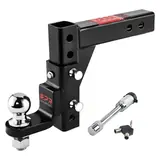 Best Adjustable Trailer Hitch Picks for Trucks (2026)Compare 5 adjustable trailer hitches with dual and triple balls, rated up to 14,000 lbs GTW, with anti-theft pins and powder coatings.Read
 How to Measure Trailer Hitch Drop, Tongue Weight & Strap WLLMeasure receiver-to-coupler drop accurately, verify 10% to 15% tongue load against door-jamb payload, and size tie-down straps by Working Load Limit.Read
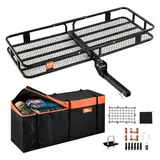 Best Hitch Cargo Carrier Picks for Trucks and SUVs (2026)Compare top hitch cargo carriers by weight capacity, basket dimensions, folding shank designs, and included weather-resistant accessories.Read
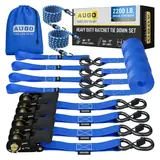 Best Ratchet Straps for Trucks and Trailers (2026)A guide to heavy-duty tie-down straps, comparing break strength, working load limits, soft loops, and auto-retracting mechanisms.Read
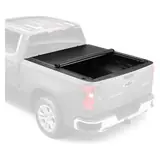 Best Tonneau Cover Picks for Pickup Trucks (2026)Compare top tonneau covers for Ford and GM trucks, from soft roll-up vinyl models to heavy-duty fiberglass tri-fold panels.Read